
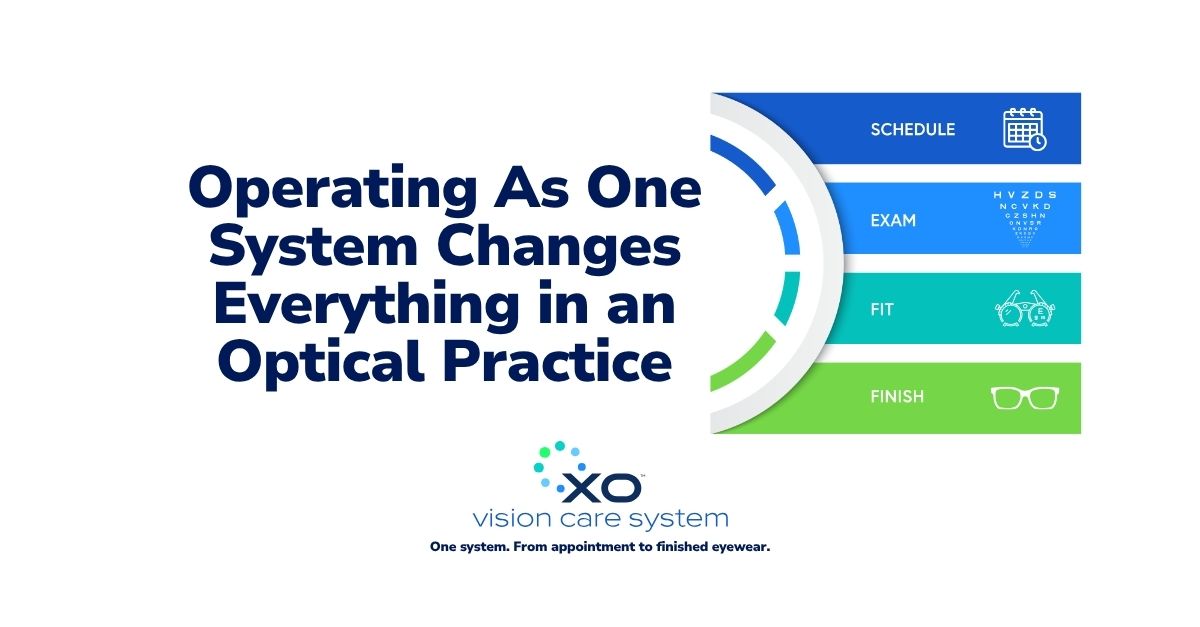
The concept of integrating the patient journey is widely understood, but far less often realized in practice.
Most optical operations still function as a series of well-managed but disconnected steps, with scheduling, exams, fitting, and fulfillment operating independently. The real shift occurs when those steps are aligned into a single, connected system. At that point, the impact is not incremental. It shows up in how the practice performs day to day, how it manages time, and how consistently it delivers care.
Throughput Becomes Predictable
In a fragmented model, throughput is often treated as a capacity issue. More patients create more pressure, and performance fluctuates based on staffing, scheduling gaps, and workflow variability.
When the patient journey is integrated, throughput becomes more predictable. Scheduling aligns with real-time capacity. Patient flow is balanced across the day. Bottlenecks are reduced because each step is informed by the previous one.
The result is not simply seeing more patients. It is seeing patients more consistently, with fewer disruptions and less variability in performance.
Time Becomes A Managed Variable
In most practices, time is something that is reacted to. Delays between steps, waiting periods, and handoffs create inefficiencies that are difficult to control.
Operating as one system changes that dynamic. When each stage of care is connected, the time between steps is reduced and better coordinated. Appointments begin to reflect actual workflow capacity, and transitions from exam to fitting to fulfillment become more immediate.
Time becomes something the practice can manage deliberately, rather than something that erodes throughout the day.
The Economics Improve Without Adding Volume
A connected system does more than improve flow. It changes the economics of the practice.
When the patient journey is integrated, fewer opportunities are lost between steps. Patients move more directly from exam to fitting. Fulfillment happens with fewer delays. The likelihood of patients completing their journey within the same system increases.
This improves capture rate, reduces leakage, and strengthens the financial performance of the practice without requiring a corresponding increase in patient volume.
The Experience Becomes Continuous
Patients do not think in terms of workflows. They experience care as a single journey.
When that journey is disconnected, even well-run practices can feel inefficient. When it is connected, the experience becomes more continuous, more predictable, and more aligned with what patients expect.
There is less repetition. Fewer delays. Clearer progression from one step to the next.
The difference is not in any single interaction. It is in how the entire experience feels from start to finish.
The Model Becomes Scalable
Once the patient journey operates as a connected system, the model itself becomes easier to replicate.
Consistency across locations becomes more achievable. Processes are standardized not as isolated tasks, but as part of a unified workflow. Performance is less dependent on individual workarounds and more rooted in how the system operates.
This creates a foundation for growth that does not rely on constantly rebuilding processes at each new location.
About Xenon Ophthalmics
Xenon Ophthalmics develops integrated technologies designed to modernize the delivery of eye care. The company’s XO™ Vision Care System connects scheduling, diagnostics, frame fitting, and in-office finishing into a unified workflow designed to expand clinical capacity while improving the patient experience.
One system. From appointment to finished eyewear.
The XO Vision Care System brings together four integrated, intelligent components — xoIris™, xoExam™, xoFit™, and xoLab™ — creating a seamless patient journey while giving practices greater operational visibility and clinical control.
If your practice is evaluating how to improve consistency, efficiency, and patient experience through a connected system, the next step is to see how it works in practice.