
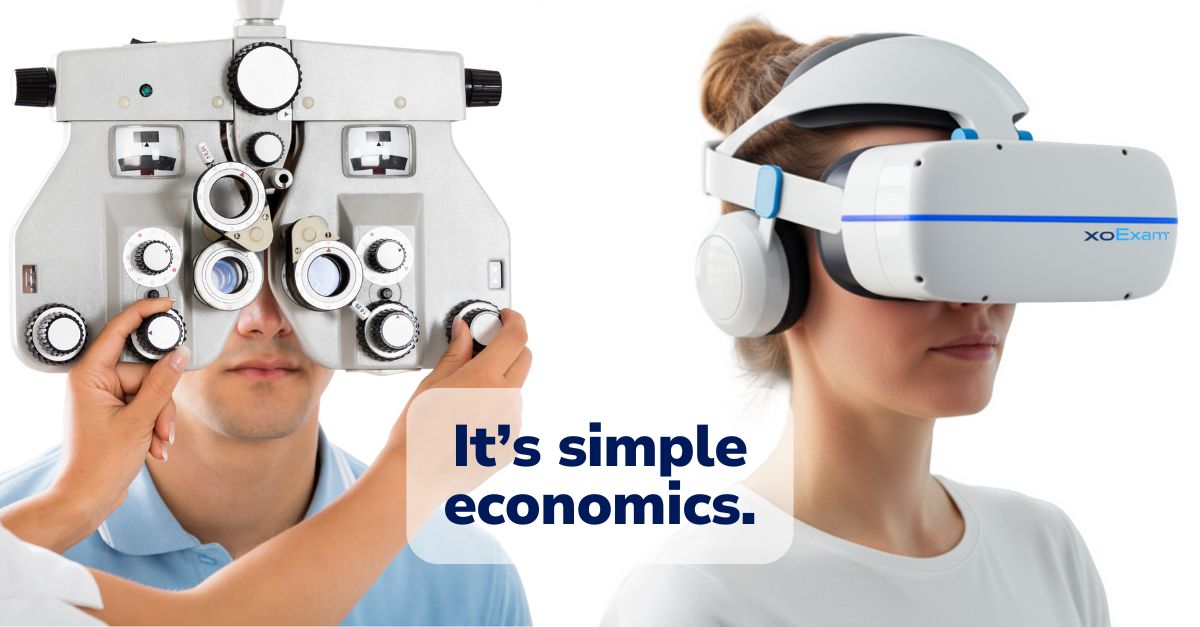
The economics of optical care have remained largely unchanged for decades.
Practices are built around dedicated exam lanes, fixed floor plans, and workflows that move patients step by step through separate stages of care. While technology within those steps has advanced, the underlying cost structure has not.
That structure is what defines how efficiently a practice can operate. It determines how many patients can be seen in a day, how much space is required to deliver care, and how much capital must be invested upfront. It also sets a ceiling on how much flexibility a practice has as demand fluctuates.
What is beginning to change is not just the technology used in eye care, but the model itself.
Fixed Infrastructure Creates Fixed Limits
Traditional exam lanes are built as dedicated environments. They require physical space, specialized equipment, and a layout that cannot easily adapt to changes in demand. Once that infrastructure is in place, the practice is effectively locked into a fixed capacity.
Adding more patients often means adding more space, more equipment, and more staff. Each increase in demand requires a corresponding increase in investment. This makes growth expensive and, in many cases, inefficient.
Even when demand is high, utilization within that structure is rarely optimized. Gaps in scheduling, delays between steps, and uneven patient flow all contribute to lost capacity that cannot easily be recovered.
Sequential Workflows Drive Cost
Most optical practices operate on a sequential, stage-by-stage model. A patient moves from scheduling to exam to fitting to fulfillment, with each step dependent on the completion of the one before it.
This creates idle time between stages. Equipment sits unused. Staff wait for transitions. Patients experience delays that extend the total visit time.
These inefficiencies are not always visible in isolation, but they compound across the day. The result is a cost structure driven as much by downtime and coordination as by actual care delivery.
Space Becomes a Constraint, Not an Asset
In the traditional model, space is one of the largest fixed costs. Exam lanes, waiting areas, and retail displays all require square footage that must be leased, built out, and maintained.
As practices grow, space requirements grow with them. This limits flexibility, particularly in retail environments or high-cost locations where square footage is at a premium.
A model that depends on physical expansion to increase capacity is inherently constrained. It ties growth to real estate, rather than to how efficiently care can be delivered.
A Different Model Changes the Economics
The XO™ Vision Care System introduces a different way of delivering care. By integrating scheduling, diagnostics, frame fitting, and in-office finishing into a single connected system, it reduces the dependency on fixed infrastructure and sequential workflows.
This changes the cost equation in several ways.
First, it reduces the amount of dedicated space required to deliver exams. xoExam™ is a medical-grade wearable exam platform that delivers 15+ automated diagnostic tests without the physical footprint of a traditional exam lane — lowering capital cost and allowing practices to scale capacity without expanding their space.
Second, it increases patient throughput by minimizing delays between steps. When the journey is connected — from xoIris™ intelligently managing scheduling and chair utilization, through xoExam™ and xoFit™, to xoLab™ completing finishing in-office — transitions become more immediate and predictable, allowing more patients to be served within the same time frame.
Third, it lowers the upfront capital investment needed to establish or expand a practice. Instead of building out multiple lanes, practices can deploy a more flexible system that scales with demand.
The result is not just greater efficiency, but a fundamentally different cost structure.
Efficiency Becomes a Competitive Advantage
As the cost structure changes, so does the competitive landscape.
Practices that can deliver care more efficiently will be able to operate with lower overhead, respond more quickly to demand, and offer a more consistent patient experience. They will also have greater flexibility in how and where they deliver care — whether in traditional clinics, retail environments, or mobile settings.
Those that remain tied to legacy infrastructure will continue to face higher costs and tighter constraints on growth.
This is not a gradual shift. It is a structural one.
About Xenon Ophthalmics
Xenon Ophthalmics develops integrated technologies designed to modernize the delivery of eye care. The company’s XO™ Vision Care System connects scheduling, diagnostics, frame fitting, and in-office finishing into a unified workflow designed to expand clinical capacity while improving the patient experience.
One system. From appointment to finished eyewear.
The XO Vision Care System brings together four integrated, intelligent components — xoIris™, xoExam™, xoFit™, and xoLab™ — creating a seamless patient journey while giving practices greater operational visibility and clinical control.
If your practice is evaluating how to improve efficiency, reduce costs, and operate with greater flexibility, the next step is to see how the system works in practice.